


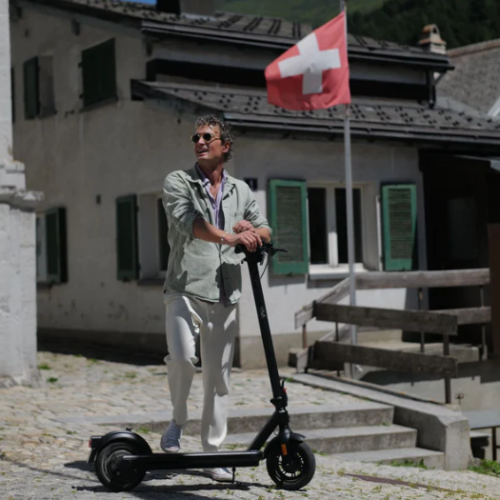



We do our best to communicate the range that you can actually achieve on a single charge. All the values we state are determined in longer tests in real use and not just on the test bench. Nevertheless, we cannot make any promises about the range you can achieve in individual cases. The range depends on too many factors.
-
Driving style
Your driving style has a significant influence on your range. You can achieve a long range if you drive with foresight and avoid sudden braking and heavy acceleration. -
-
Route
Do you ride a lot on flat terrain or are there a lot of inclines? This question is crucial. Your scooter needs significantly more energy uphill, so you can ride much further at a constant 20 km/h on flat terrain than on hilly terrain. The road surface also plays a role: gravel or lots of bumps reduce the maximum riding distance
-
Temperature and weather
A lithium-ion battery feels most comfortable at temperatures where most people also feel comfortable: Around 20° Celsius. Especially in cold temperatures, the range quickly drops to a small part of the original range. But very warm temperatures also put a strain on the battery and reduce your range. This is about the temperature of the battery or the immediate vicinity of the battery - so don't necessarily leave the scooter in the blazing midday sun, but find it a shady spot when it is not being ridden.
The wind can of course also affect the range - depending on the wind direction, it will either help you or reduce the range. -
-
Rider
You also influence the scooter yourself: tall people in particular have a higher air resistance that the scooter has to overcome - which is why skiers, for example, crouch down. In addition, the weight of the rider influences the energy required by the scooter: even in a car, you notice a difference depending on the load. In a car, the weight of the rider only accounts for a few percentage points of the total mass, whereas on a scooter the rider usually weighs many times more than the vehicle. -
-
Battery condition
The condition of the battery is often described as the age of the battery. This is not mainly about the time that has passed since production, but primarily about how often the battery has been charged. This is referred to as charging cycles. A charging cycle is a charge from 0% to 100%. A charge from 25% to 75% is half a charge cycle.
If the battery has undergone several charging cycles, the capacity of the battery decreases noticeably. If the scooter is left for a long time with a very high or very low battery level, this accelerates ageing. The best way to protect the battery is to keep the charge level between 20% and 80% and only leave this range in exceptional cases.
Storage at extreme temperatures or charging at extreme temperatures can also damage the battery - you can find more tips on this topic at . -
-
Air pressure
Riding with insufficient air pressure damages the scooter - that much in advance. The air in the tire cushions impacts on the bearings and the frame; without this spring effect, the service life of the scooter can be massively reduced.
At the same time, low air pressure also increases the friction of the tire. This leads to a massive reduction in range is used. For a long range, the air pressure should be at the upper end of the recommended range. You can find the recommendations here.
-
Riding mode
As the name suggests: In ECO mode, you save energy, while in Sport mode you are more agile and lively. You can cover significantly shorter distances in Sport mode. -
-
Kickstart
The zero-start function is pleasant. You don't have to push off at the traffic lights, but can accelerate directly at full power. However, starting off is also a demanding process for your scooter, so zero-start mode can cost you a few kilometers of range.