


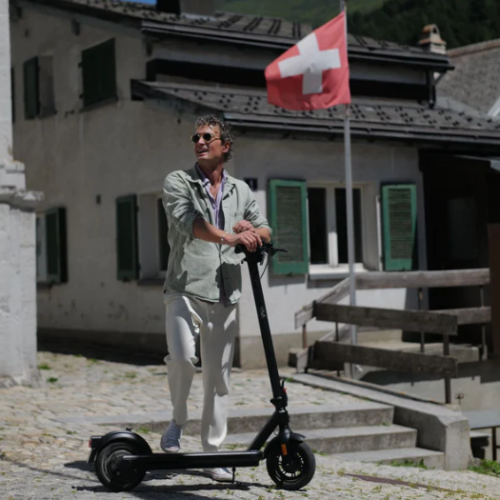



In brief: Commuter e-scooters are designed for efficiency, weight and everyday use. Performance models offer more power reserves for inclines, higher loads and more demanding routes. The decisive factor is not "more power", but the right purpose.
You can find more background information in our model comparison overview.
What is the difference between commuter and performance models?
The difference lies not in the top speed - which is limited to 20 km/h in Switzerland - but in the power reserves, weight, design and intended use.
Basic principle:
Commuter models are optimized for efficiency. Performance models are optimized for load and incline.
If you want to go deeper: Here you will find an overview of e-scooters for commuters as well as an overview of performance e-scooters.
What makes a commuter e-scooter stand out?
Commuter e-scooters are designed for daily, predictable routes. Typical commutes are between 3 and 10 kilometers.
- Balanced ratio of power and weight
- efficient range in everyday use
- easier to transport
- focus on reliability
Here we explain why every kilo counts: The weight of e-scooters in everyday life.
What makes a performance model?
Performance models are designed for more demanding conditions: steep routes, higher payloads or longer distances.
- Higher peak power
- Greater climbing ability
- more robust construction
- greater power reserves
Think further:
Here we explain why not only watts but also torque is decisive: Watts vs. torque for e-scooters.
If you would like an even broader overview of performance, you can find an overview of performance e-scooters here.
Direct comparison in everyday life
The following overview shows typical differences:
- Commuter: lighter, efficient, ideal for flat to moderate routes
- Performance: stronger, more stable under load, better for inclines
- Commuter: ideal for public transport combination
- Performance: useful for heavier riders
We explain here how much incline can be realistically managed: E-scooter incline simply explained.
Common misconceptions
"More watts is automatically better."
Not necessarily. The decisive factor is how the power is available in everyday use.
"Performance models are always oversized."
In hilly regions, power reserves are a real comfort factor.
"Commuter models are weak."
They are optimally tuned for the intended use.
Which model is suitable for whom?
A commuter model is particularly suitable for
- regular short journeys
- public transport combination
- lighter rider weight
If you are mainly on the move every day and want to be able to plan ahead, this overview of e-scooters for commuters will help you.
A performance model is particularly worthwhile for
- hilly surroundings
- higher payload
- Desire for power reserves
Conclusion - not stronger, but more suitable
The decision between commuter and performance depends on your everyday life - not on marketing claims.
You can find a structured overview of all models on our model comparison page.
Frequently asked questions (FAQ)
Is a commuter e-scooter sufficient for inclines?
A commuter model is usually sufficient for moderate inclines. For regular inclines of more than 15-20%, power reserves are useful to ensure that the e-scooter remains stable and controlled.
Are performance models faster?
No. In Switzerland, the maximum speed is limited by law to 20 km/h. The difference lies in acceleration, climbing ability and power reserves - not in the top speed.
Is a performance e-scooter impractical in everyday life?
Not in principle. Performance models are often somewhat heavier and more robust. If you use the e-scooter regularly or combine it with public transport, you should take the weight into account.
Which model makes more sense in the long term?
That depends on the usage profile. A commuter model is sufficient for short daily journeys. If you ride in hilly areas or need a higher load capacity, you will benefit from a performance model in the long term.


